Abstract
Total ankle replacement (TAR) is a complex surgical procedure that can significantly improve the quality of life for patients with debilitating ankle conditions, such as end-stage arthritis. However, access to surgeons skilled in performing TAR is limited in rural areas due to geographic isolation, economic barriers, and a shortage of specialized healthcare providers. This study aims to assess the distribution of TAR-trained foot and ankle surgeons and explore the challenges faced by rural populations in accessing this crucial care. By using the “Find a Surgeon” tool from Stryker’s website, we identified 479 podiatric surgeons and 518 foot and ankle orthopedic surgeons across the U.S., noting that only 31 of these professionals practice in rural areas, defined by the U.S. Census Bureau as towns with populations below 5,000. Key obstacles to accessing TAR in rural areas include long travel distances, economic disparities, limited healthcare coverage, and a lack of awareness about available treatment options. Despite the limitations, we hope to highlight the hurdles many patients have to overcome for access to surgeons who perform TARs.
Introduction
Total ankle replacement (TAR) has emerged as an increasingly utilized surgical option for the management of end-stage ankle arthritis and other debilitating ankle pathologies, offering the potential for pain relief, preservation of joint motion, and improved functional outcomes. Advances in implant design, surgical technique, and perioperative management have expanded indications for TAR, particularly among older adults with chronic ankle conditions such as degenerative arthritis. Despite these advancements, TAR remains a technically demanding procedure that requires specialized surgical training, advanced surgical infrastructure, and coordinated multidisciplinary care.
As demand for TAR continues to rise, disparities in access to surgeons trained in this procedure have become increasingly apparent. Access to specialized foot and ankle surgical care is not uniformly distributed across the United States, with a disproportionate concentration of TAR-trained surgeons practicing in urban and suburban centers. , Patients residing in rural and underserved areas often face substantial barriers to care, including limited availability of subspecialty surgeons, extended travel distances, financial constraints, and fragmented referral pathways. , These barriers may result in delayed evaluation, reduced utilization of TAR, and prolonged disability, even when surgical intervention may be clinically appropriate.
Importantly, existing literature suggests that rural residence alone does not necessarily confer inferior surgical outcomes following total ankle arthroplasty once care is accessed. Prior studies have demonstrated no significant rural–urban differences in inpatient outcomes such as length of stay, discharge disposition, or in-hospital mortality following TAR. Instead, disparities appear to be driven primarily by differences in access, utilization, and healthcare delivery infrastructure rather than by patient suitability or surgical quality. Broader orthopedic rural health literature further highlights that rural populations experience differences in healthcare utilization patterns, including lower rates of specialty care use, delayed care-seeking behavior, and greater reliance on primary care services. ,
Understanding the geographic distribution of TAR-trained surgeons and the systemic barriers faced by rural populations is therefore essential to addressing inequities in care delivery. The purpose of this study is to characterize the geographic distribution of podiatric and foot and ankle orthopedic surgeons performing TAR across the United States, with particular emphasis on rural access. By identifying regional gaps in surgeon availability and examining structural barriers to care, this manuscript aims to highlight opportunities for targeted interventions and propose strategies to improve access to total ankle replacement for patients living in rural and underserved communities.
Materials and methods
To identify podiatric surgeons performing Total Ankle Replacement (TAR), the “Find a Surgeon” tool on the Stryker website was utilized. This publicly accessible database allows patients to search for surgeons based on geographic location, with search radii of 25, 50, 75, 100, and 250 miles. To ensure a comprehensive nationwide assessment, central search points were strategically selected across the United States.
The Big Radius Tool from StatsAmerica.org was used to calculate and verify the counties encompassed within a 250-mile radius of each selected central location, ensuring appropriate geographic coverage and minimizing regional overlap. Using these search parameters, podiatric surgeons and foot and ankle orthopedic surgeons performing TAR were identified and cataloged.
All surgeons were accessed via the “Find a Surgeon” tool as of December 10, 2025. Surgeons were recorded in a standardized spreadsheet, including first and last name, professional degree, and city of practice. Duplicate entries were identified and removed through manual review to ensure accuracy.
Demographic data for each city, including population size, were obtained from the U.S. Census Bureau to contextualize surgeon distribution relative to population density. Rural communities were defined according to U.S. Census Bureau criteria as towns with populations below 5,000. This methodology was designed to provide a representative assessment of TAR surgeon distribution across urban, suburban, and rural regions of the United States.
Results
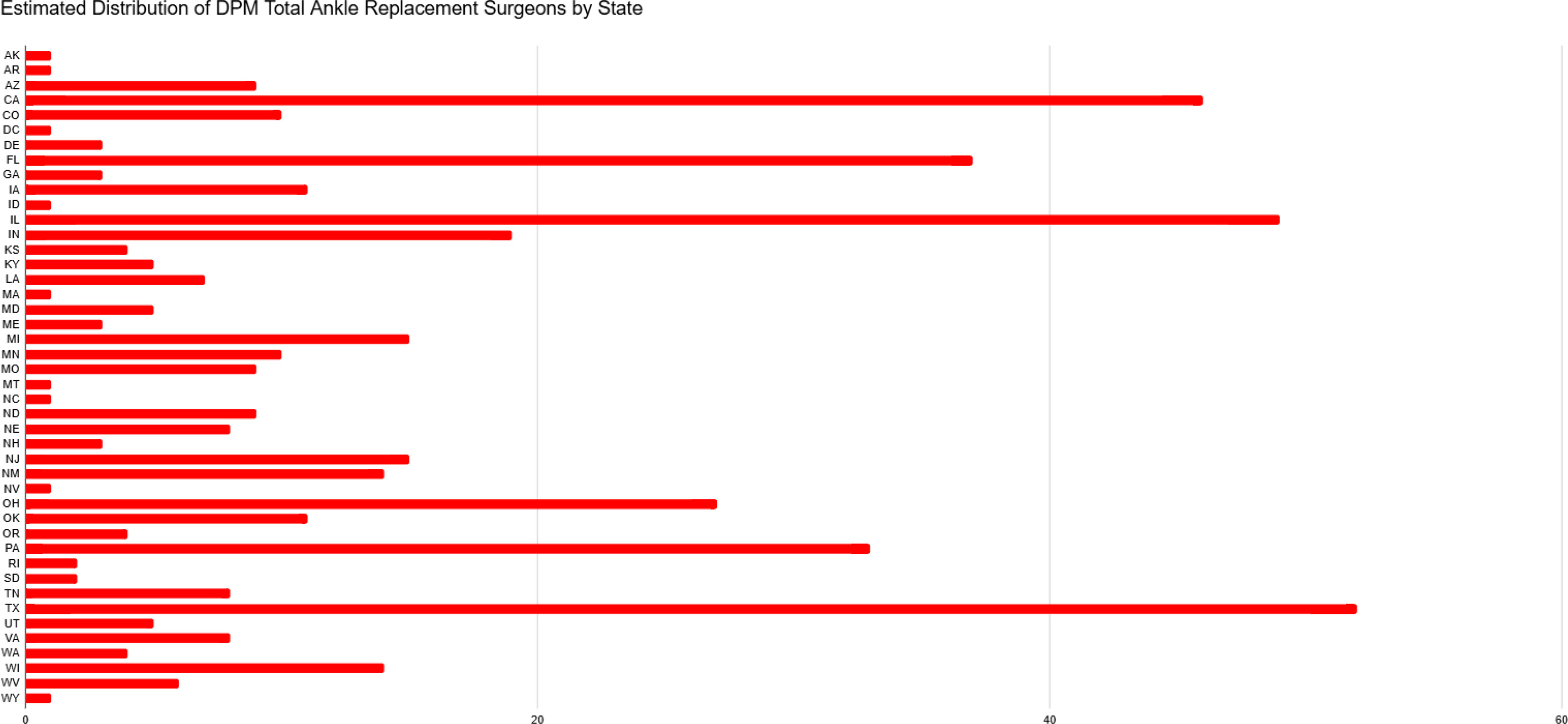
A total of 479 podiatric surgeons and 518 foot and ankle orthopedic surgeons performing TAR were identified across the United States using the Stryker “Find a Surgeon” database. Geographic distribution ( Figs. 1 , 2 and Tables 1 , 2 ) demonstrated a marked concentration of TAR-trained surgeons within urban and suburban regions. This pattern is consistent with prior national utilization studies demonstrating that TAR is disproportionately performed in large, high-volume urban and academic centers, where procedural volume, implant availability, and institutional infrastructure support complex ankle reconstruction. ,
United States Map with distribution of surgeons who provide Total Ankle Replacement.
Estimated geographic distribution of Total Ankle Arthroplasty (TAR)-trained foot and ankle surgeons in the United States.
Table 1
Estimated distribution of DPM Foot and Ankle surgeons who perform total ankle replacement per state.
|
Related posts:


Stay updated, free articles. Join our Telegram channel

Full access? Get Clinical Tree


